




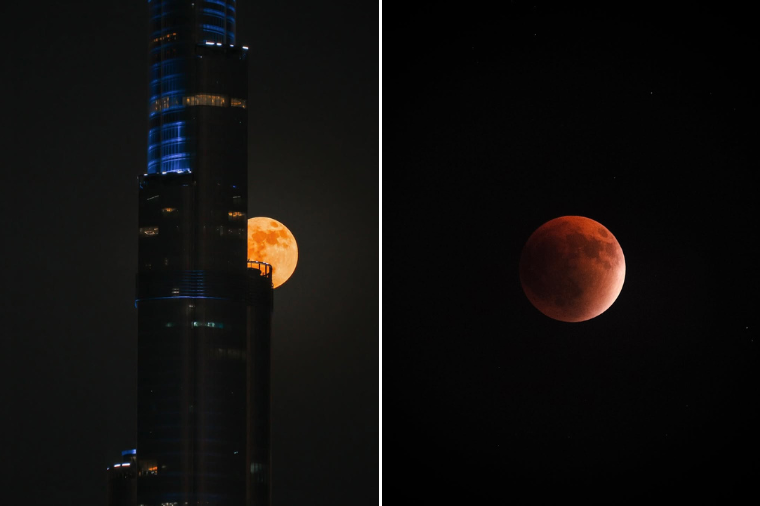
Billions around the world, and thousands across the UAE, looked up this past weekend to witness one of the most profound celestial spectacles: a total lunar eclipse. As the Earth’s shadow crept across the surface of the Full Moon, it transformed our familiar silvery neighbour into a deep, coppery-red orb—a phenomenon known as a Blood Moon. For skywatchers in Dubai, Abu Dhabi, and beyond, the event offered a rare and breathtaking display that won’t be seen again in our skies for over three years.
View this post on Instagram
Here’s how the unforgettable astronomical blood moon event unfolded
Understanding the Eclipse
A lunar eclipse occurs when the Earth aligns perfectly between the Sun and the Moon, casting its shadow upon the lunar surface. This particular event was a total lunar eclipse, meaning the Moon was entirely engulfed by the darkest part of Earth’s shadow, the umbra.
The journey through shadow happens in distinct phases:
Penumbral Eclipse: The Moon enters Earth’s faint outer shadow. The dimming is very subtle.
Partial Eclipse: The Moon moves into the umbra, and a dark “bite” appears to slowly consume it.
Total Eclipse: The Moon is completely within the umbra, illuminated only by sunlight filtering through Earth’s atmosphere, causing the iconic red glow. The process then reverses as the Moon moves out of the shadow.
Why did the moon turn red?
The magic of the Blood Moon is explained by a beautiful trick of our own atmosphere. During totality, no direct sunlight can reach the Moon. Instead, the only light that illuminates it is sunlight that has been filtered and bent around the edges of the Earth.
This process, called Rayleigh scattering, is the same effect that gives us vibrant red sunrises and sunsets. Earth’s atmosphere scatters the shorter blue light wavelengths and allows the longer red wavelengths to pass through, essentially projecting a ring of every sunset and sunrise on Earth onto the surface of the Moon, bathing it in a breathtaking crimson hue.
View this post on Instagram
A minute-by-minute round up
From quiet back gardens to organised viewing events at locations like the Mohammed Bin Rashid Library (MBRL), the UAE was captivated. Here’s how the evening’s drama played out:
8:24 PM: The subtle penumbral eclipse began, a soft whisper of the show to come.
8:37 PM: The main event truly started as the partial phase became visible. A distinct, dark shadow began taking a “bite” out of the brilliant Full Moon.
9:14 PM: Across the UAE, many Muslims observed the special Salat al-Kusoof (eclipse prayer), a time for supplication and remembrance.
9:41 PM: The moment everyone waited for. The total eclipse began, and the Blood Moon revealed itself in all its coppery-red glory, casting an eerie and beautiful light across the desert landscape.
10:12 PM: The eclipse reached its peak, with the Moon displaying its deepest and most captivating crimson hues.
10:53 PM: The total phase concluded, and the Moon began its gradual emergence from the umbra, slowly returning to its familiar self over the next hour.
The entire event, from the first penumbral shadow to the last, concluded at 12:55 AM on Monday, September 8, offering UAE residents a spectacular five-hour celestial performance.
When can you watch the next blood moon in the UAE?
For those who witnessed it, the memory of the deep red Moon hanging in the clear UAE night sky will linger. This was a true once-in-several-years event. While the eclipse is now over, it has set the stage for the next great astronomical show.
Mark your calendars: the next total lunar eclipse visible from the UAE will occur on December 31, 2028. However, the rare phenomenon of the moon turning red is only predicted to occur after 3 years.
– For more on luxury lifestyle, news, fashion and beauty follow Emirates Woman on Facebook and Instagram
Images: Supplied & Feature Image: @alanood.mubarak @aljvd


