


In the UAE’s fast-growing cultural landscape, Emirati artist Azza Al Qubaisi has become one of the most resonant voices translating heritage into contemporary form. Her latest project, which opened the week-long Art in Motion event at Souk Madinat Jumeirah, is just the most recent example of her artistic ethos: collaborative, rooted in tradition, and deeply committed to community connections.
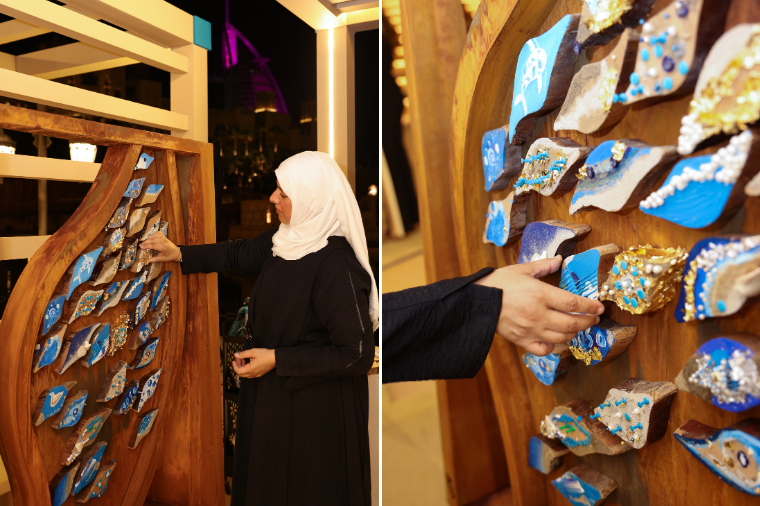
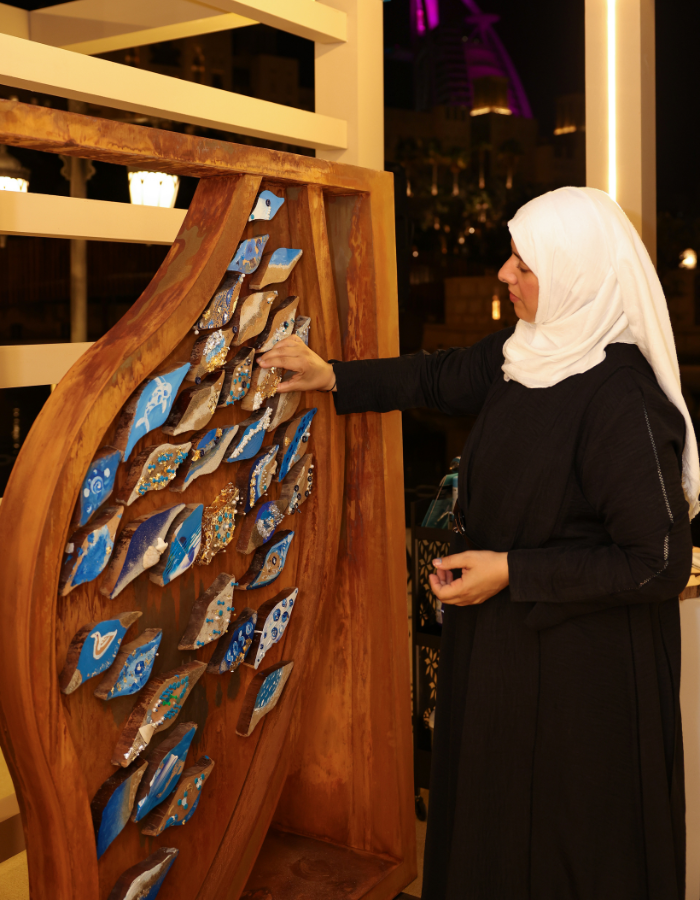
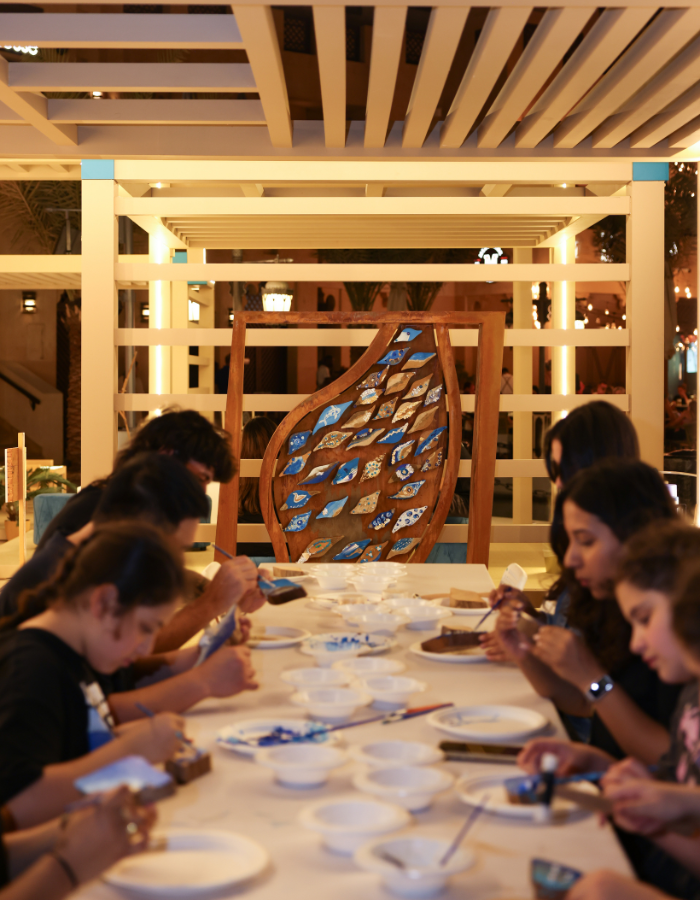
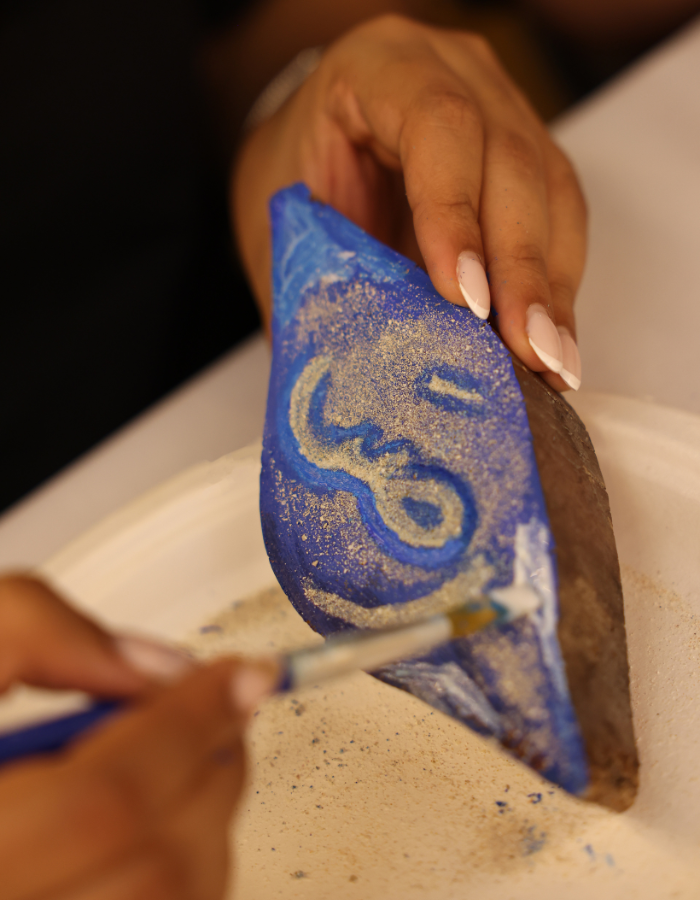
Al Qubaisi was invited to kick off the Art in Motion initiative with a workshop inspired by the symbolic Palm Eye, a gesture that perfectly reflects her long-standing fascination with the materials and iconography of the region. “I proposed doing the workshop where the audience would be able to engage with the palm through the palm eye and express themselves,” she explains. Using sand, leaves, rope and thread participants were invited to add their personal touch to her collaborative installation. An artwork that will remain on display at the Souk through the Union Day holiday this month.
For Al Qubaisi, who began her artistic career in 2002, projects like this represent the evolution of her creative journey as well as the evolution of the UAE’s art ecosystem. When Jumeirah approached her about the project, it immediately held a unique appeal. “I totally loved it,” she says, “because I don’t think I’ve ever run a workshop anywhere close to Madinat Jumeirah or the souk itself. So to me, it is a new audience, and it’s a unique audience as well.” The open-door nature of the event, free, unbooked, and spontaneous, was particularly meaningful. “We don’t usually get many events like that,” she admits. “It is open to the public to come and enjoy it as they please.”
That openness reflects a shift in her own practice over the past decade and a half. What began as a career rooted in jewellery and small-scale sculptural works has expanded into large public installations and art-making designed with interaction in mind. “Engaging with the community and allowing the community to be part of my artwork is something that has evolved in the past 15 years,” she explains. “I realized I enjoyed empowering the community to see themselves as creatives.”
This belief, that creativity is a shared space rather than a solitary endeavor, has become one of the defining threads in Al Qubaisi work. Her installations across the UAE often invite viewers to walk around, move through, or physically engage with the pieces. This approach, she notes, is tied to her background in jewelry. “The pieces are not made to be looked at, but are made to be worn,” she says. “So the touching, feeling, experiencing is something that I’ve carried forward in my practice.”
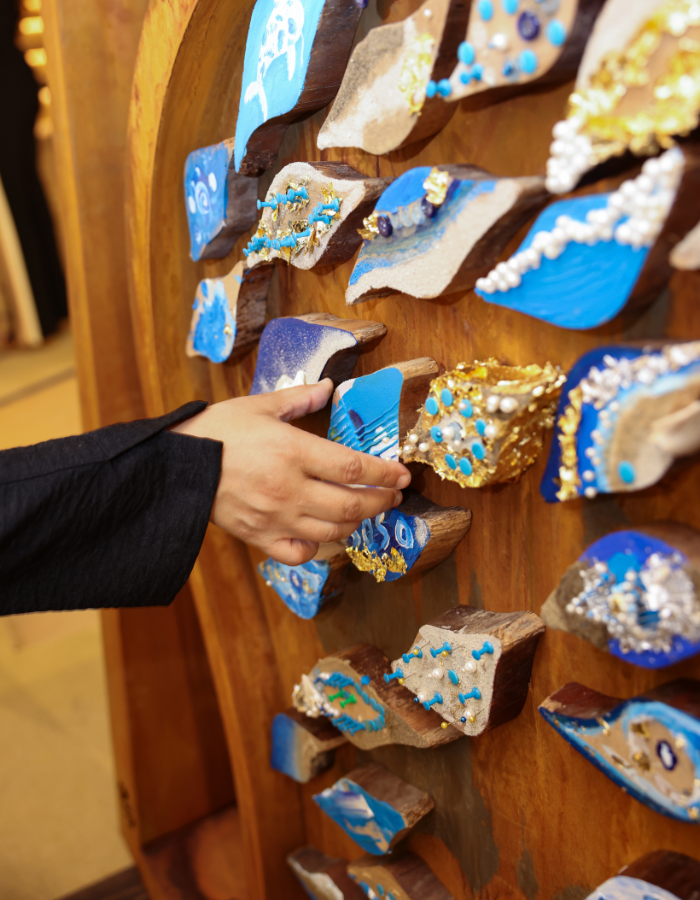
Her workshop at Souk Madinat Jumeirah illustrates this tactile philosophy, but it also demonstrates her instinct to reinterpret heritage in unexpected ways. Instead of relying on familiar motifs, she challenges viewers to look again. “They always presume it’s another camel,” she says of tourists encountering Middle Eastern art. “With my piece, they have to think twice to understand what it is.” The materials, sand in five shades, palm fronds, rope, and the occasional flash of gold or silver leaf, reflect both simplicity and symbolism. “Having humble materials such as the sand and the palm fronds gives a different perspective,” she says, “and I love the impact that engaging with the art can have on people, it instantly makes it more personal and profound.”
In many ways, Al Qubaisi’s practice mirrors the development of the UAE’s art world itself. When she began, opportunities were limited. Today, she sees extraordinary growth. “It is huge,” she says of the shift. “Art education in itself is available in the country in different universities… and from a perspective of grants, we never had grants back when I started. Now the grant system has been established… which is phenomenal.” She calls this moment “the golden period,” pointing to the rise of biennials, public art programs, commissions, and artist support structures that simply did not exist two decades ago.
Her own career is a testament to this cultural momentum. She has created major public sculptures, including a large-scale work exhibited in Abu Dhabi and collaborated on projects with brands like Bvlgari. “Would I have dreamed of having so many different public pieces? Not really,” she admits. “I never even thought I’d be reaching that point.”Her material language has strengthened over time as well. Palm fronds remain a pillar in her work but metals such as mild steel and stainless steel have also become key elements, particularly in her public pieces. The rusted finishes that appear across her large-scale works have become subtle signatures. And while she occasionally returns to gold and silver, these precious metals anchor her earlier jewelry practice more than her monumental sculptures.
Still, whether working with steel or palm, Al Qubaisi’s art is always grounded in story. “I think it’s the story that my pieces carry that people connect with,” she notes. Those stories often begin with heritage, but they expand outward to the idea of community, to place, to participation, to memory. As she moves forward, Al Qubaisi is thinking increasingly about legacy. Not legacy in the traditional institutional sense, but legacy as a lived and shared experience. In the past four years, she has been building her own home in Abu Dhabi, designed with intention and purpose. “That space has become now like my mini museum,” she says, describing its reimagined majlis. “I’ll probably be keeping it open for the public to come and see my work or visit me.” She is also planning on creating an artist residency within the space, hosting both local and international creatives. “Building that kind of connection is something I see as important,” she explains.
This investment in connection runs parallel to her preparations for her next solo exhibition. “It would be a good way for me to focus again and create a new series of pieces,” she says, though the themes are still taking shape. For now, completing her home – and with it, the community space she envisions – is the priority. “My main focus is just finishing my house,” she notes, aiming for late 2025 or early 2026.
In many ways, the collaborative Palm Eye installation at Souk Madinat Jumeirah encapsulates the essence of Al Qubaisi’s evolving artistic identity. Yes it is grounded in heritage, but it is brought to life through conversation, participation, and shared creativity. It underscores her belief that art should not only be viewed, but experienced; not only admired, but contributed to; not only preserved, but lived with. After all, it’s how we interact with, and react to, art that can have powerful ripple effects across generations.
– For more on luxury lifestyle, news, fashion and beauty follow Emirates Woman on Facebook and Instagram
Images: Supplied & Feature Image: Supplied


