




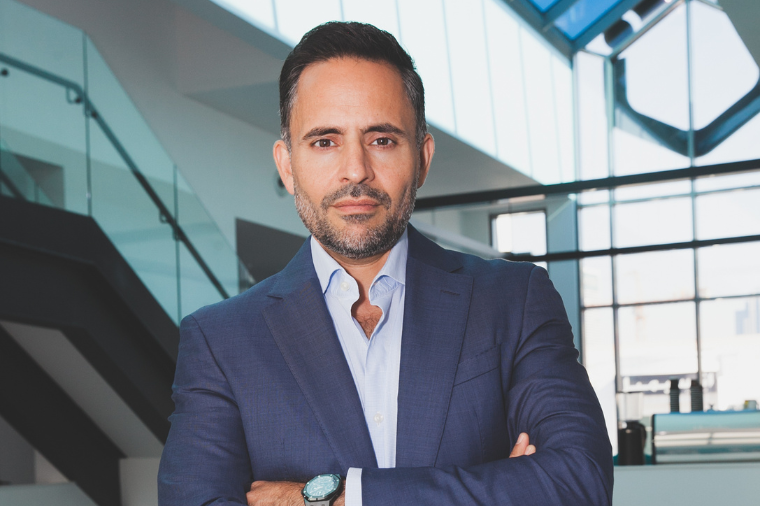
Ali Hashemi, co-founder and chairman of meta[bolic], GluCare.Health, and Zone.Health, reveals the future of AI healthcare, balancing empathy and algorithms, and his most coveted health hacks
What do the first 30 minutes of your day look like?
Well, I’d love to say I start with quiet introspection, mindful meditation, or a perfectly optimised morning routine. But the truth is, most mornings begin with one of our kids as nature’s alarm clock – jumping into bed with some urgent question or deciding it’s the perfect time to start practicing piano. It’s always some version of beautiful chaos: breakfast negotiations, backpack packing, uniform hunting, and trying to get everyone out of the door on time. The one thing I’ll always do is grind my 18 grams of freshly roasted coffee beans and press myself a double espresso on my Rocket machine. Post school run, I try to make it to a morning yoga session one or two times per week. That’s usually the first real moment of calm in the day. That said, I do check my biometrics first thing (HRV, sleep score, resting heart rate) from my Oura Ring, it has helped me improve sleep hygiene immensely.
What inspired you to launch meta[bolic]?
It was personal. My grandfather passed away from complications related to diabetes. Both of my co-founders have fathers who are diabetic. So we all understood firsthand, the emotional and physical toll of living with metabolic disease. But beyond the personal stories, there was a very rational angle. This was back in 2019, and I had just sold my first company, Amana Healthcare. For the next chapter, I was looking for a systemic problem in medicine worth solving – one with massive scale, immense societal impact and under-leveraged data. Diabetes stood out. It’s a condition that generates more daily data per patient than almost any other chronic illness. And yet the way it’s treated globally is still fragmented, reactive, and reliant on sporadic appointments and outdated protocols. So clearly, whatever we’re doing – it doesn’t work. At the same time, wearables were becoming more sophisticated, straddling the divide between wellness and clinical relevance. So, we found ourselves in a world that’s becoming increasingly data rich but insight poor. meta[bolic] was built to flip that paradigm, to turn data into insight, insight into action, action into outcomes – and to do that at scale. We set out to make care continuous, proactive, and deeply human. Meta[bolic] powers two platforms – GluCare.Health that looks after primarily our Diabetic population, and Zone.Health that has evolved to be our healthspan offering (including medicated weight loss, hormone replacement therapy, men’s health and TRT, perimenopause and women’s health).
View this post on Instagram
GluCare.Health is the first ICHOM-accredited metabolic clinic – why does this matter to patients?
The International Consortium for Health Outcomes Measurement (ICHOM) is a non-profit organisation, founded out ofHarvard and the Boston Consulting Group, transforming the global health care system by developing and promoting standardised, value-based healthcare frameworks. These are clinical and quality-of-life guidelines that place patients at the centre of care, prioritising quality and efficiency. It matters because ICHOM focuses on what patients actually care about: outcomes that affect their lives, not just what shows up in lab results or billing codes. It holds us accountable not just for delivering care, but for delivering results. And in our domain, results are very easily quantifiable – weight loss, ALC reduction, improved energy, reduced medication dependence. But there’s a deeper issue worth addressing here. The single biggest impediment to value-based care in insurance-driven markets is the 12-month contract model. Insurers have no real incentive to invest in long-term health outcomes if they might not retain the member next year. That forces short-term thinking – treating symptoms, not systems. Our model challenges that. We’ve proven, for example, that by closely monitoring a patient’s glucose, sleep, diet, stress, and movement in real time, we can help them achieve incredible outcomes. That’s the power of continuous care. But it requires a new kind of commitment from both the care provider and the system around them.
What’s the biggest challenge you’ve faced, and how did you overcome it?
Getting expelled from medical school (three times in total!) was a defining moment. It wasn’t about academics; it was about being a square peg in the round hole of a rigid, hierarchical system. As president of the student body, I challenged some of the deep-seated governance failures at the school. That didn’t sit well with the leadership, and it taught me a swift, hard lesson: power dynamics can be ruthless and unfair. At the time, it felt like a catastrophic failure. In hindsight, it was the best thing that ever happened to me. It forced me onto an unknown path and taught me resilience from first principles. That experience gave me grit, but more importantly, it taught me to have gratitude for adversity.
What’s a “health hack” you swear by that most CEOs wouldn’t expect?
I call it the pragmatist’s approach to longevity. It’s not glamourous, costs nothing to do, but it will change your life: treat sleep like a job, eat whole foods, walk often, especially after meals, lift heavy (to failure), manage stress and maintain strong relationships. Also, wearing a CGM (continuous glucose monitor), even if you’re not diabetic, is eyeopening. You begin to understand how your body actually works, not in theory, but in real time. People obsess over food and exercise, but if your sleep is poor, you’re metabolically compromised. Full stop. I treat sleep as a cornerstone, not a luxury.
What’s a disruptive health trend you’re skeptical about?
Any trend that equates health with optimisation for its own sake. I’m cautious around the obsession with biohacking as performance theatre, endless supplements, exotic devices, and extreme routines. A lot of it feels like an expensive distraction from what really works: movement, sleep, quality food, strong relationships, and context-aware medical care.
What’s one lesson you’ve learned about yourself through building meta[bolic]?
That urgency and patience can live together. You can build fast while thinking long. But maybe the most important lesson? Anything meaningful is inevitably messy. The systems we’re trying to change weren’t built for transformation, they were built for inertia. You have to keep showing up, again and again.
How does meta[bolic]’s real-time wearable data drive better outcomes than traditional care?
Traditional care is episodic – you show up to the doctor’s office once you have a problem, explain what’s been going on, and likely walk out with a medication prescription and a “see you next year!” Once you leave that doctor’s office, they’re blind to what’s happening to you, and if you’re making any progress. It’s reactive by design. And it’s always behind the curve. Patients at meta[bolic] are supported by a dedicated care team that includes a physician, dietitian, and lifestyle coach. This team monitors their progress in real time through our app, which integrates wearable tech like continuous glucose monitors (CGMs) and the Oura Ring. These devices track everything from blood sugar and sleep to stress and physical activity, giving both the patient and care team a full, upto- date picture. This hybrid model blends digital monitoring with hands-on clinical care, making it possible to intervene early and adjust treatment as needed.
How do you break the stigma on taboo topics at meta[bolic]?
By naming them directly. The moment you bring something into the light – whether it’s sexual health, emotional burnout, metabolic dysfunction – it stops being taboo and starts being clinical. We strip shame from the equation by grounding everything in data and science: our model is built on data-driven care and continuous monitoring, which means we’re constantly engaging with real, lived experiences. We’ve also benefited from a broader cultural shift. You now have credible voices like Dr. Peter Attia and Dr. Andrew Huberman talking about these topics in depth, with science-backed nuance.
Where are you placing your next big healthtech bet, and why?
We’re building a health credit system – what we call Longevity Credits. It will be designed to give payers a reason to invest in long-term health, not just short-term fixes. The big idea is to align everyone in the healthcare ecosystem, including patients, insurers, and employers, around the same incentive: prevention. That means developing infrastructure that can verify real outcomes (based on biomarkers, not just behaviour), and create financial rewards for staying healthy. It’s ambitious, but inevitable. Because if we don’t start financially valuing prevention, we’ll keep paying dearly for treatment. What does success look like to you now, personally and professionally? Once you become a father, your kids become a mirror to your soul, and success on the most fundamental level means raising happy, healthy and well-adjusted kids that go on to contribute positively to society. So, success, for me, lives in legacy – not in what I’ve built, but in what it inspires. In a world where your digital footprint now lives forever, I want that history to show that I improved people’s lives in a meaningful way. Professionally, it’s about building systems that scale without losing their integrity. If meta[bolic] becomes the reference model for real metabolic and preventive care globally, then we’ve done our job.
Where do you see meta[bolic] in the next 5 years?
As the gold standard for metabolic care globally – not just in clinics, but as a platform that underpins how prevention is delivered at scale. We’re expanding into the US and UK, launching new programs that go far beyond diabetes, and integrating AI more deeply into the care experience. meta[bolic] should always feel personal, intelligent, and grounded in science, no matter how big it gets. And the only thing that really matters is the agency that we give our patients to become better versions of themselves.
Emirates Man’s Fall/Winter 2025 Issue – Download Now
– For more on how to look smart and live smarter, follow Emirates Man on Facebook and Instagram
Images: Supplied


