


ROM SAND TO SKYLINE
The United Arab Emirates was not yet four years old when its General Women’s Union was established. Created under the presidency of HH Sheikha Fatima bint Mubarak, Mother of the Nation, in August 1975, it was a bold, decisive move for a country still in its infancy. The union – a guiding force for women’s empowerment and female leadership – was an early signal of the value the UAE would place on women as equal partners in building what the country would become: a beacon of ambition, tolerance, and power for women. At the time, the UAE’s population was estimated at around 550,000 – a shadow of the over 11 million people who now call the Emirates home. Yet the seeds of empowerment had already been sown, championed by the UAE’s Founding Father, the late Sheikh Zayed bin Sultan Al Nahyan, who famously said: “Nothing could delight me more than to see the woman taking up her distinctive position in society. Nothing should hinder her progress. Like men, women deserve the right to occupy high positions according to their capabilities and qualifications.”
The status of women has flourished in parallel with the UAE’s extraordinary growth. Monumental moments have led change, but so have quieter, consistent developments in everyday life. Recalling her childhood, HH Sheikha Lateefa bint Maktoum, founder and director of contemporary art and design studio Tashkeel and Emirati fine-dining restaurant Gerbou, says: “Dubai was much smaller, quieter, and more intimate. I have had the privilege of watching Dubai transform enormously within my lifetime. What interests me now is not only how much we have built, but how we carry forward what existed before us. That thinking informs much of what I do. I am very interested in memory and identity, but I don’t believe culture is preserved by simply recreating the past. It has to be lived and allowed to evolve.”
For fashion designer and founder of DAC Communications Dima Ayad, her early years in Dubai remain vivid. She arrived in Dubai from Lebanon 44 years ago, aged just 2, after her mother fled Beirut by boat to Cyprus with her and her sister. The family checked into the Hyatt Regency as a temporary measure, but it turned into her home for the next 24 years. Growing up in 1980s Dubai, she says, was defined by community. “Everybody knew everybody,” Ayad reflects. “Wherever you went, it was about the connections you made more than the places you went to.” The multicultural fabric was already firmly woven. “It was just as diverse then as it is now,” she says.
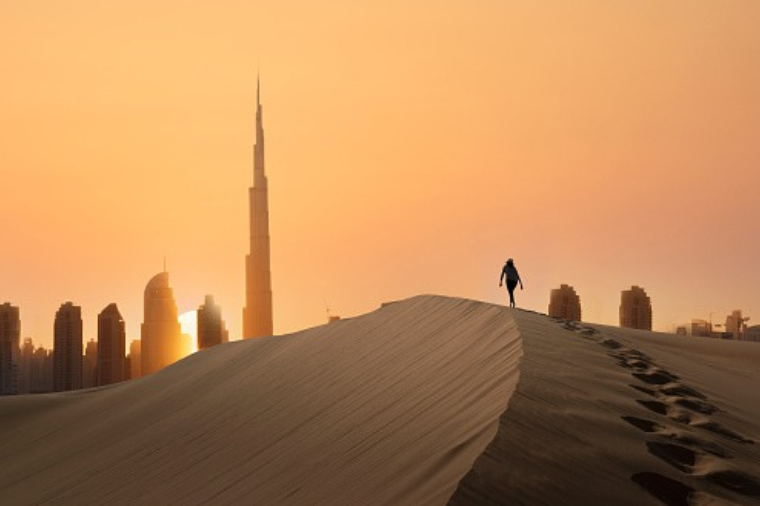
Throughout her childhood, Ayad watched the city’s ambitions take shape outside her window – quite literally. “Sheikh Zayed Road was sand. The view from my window was sand,” she says. “And then it just became this concrete jungle.” What stayed with her was that every promise was kept. “Everything they said they were going to do, they did,” she recalls. “They said they were going to create these two iconic towers on Sheikh Zayed Road, and when I graduated, I ended up working in those towers. Everything sounded so far-fetched. That’s how I came to believe that impossible was nothing.” That belief would later fuel her own leap into fashion – a business born almost by accident, when the dresses she made for herself, then her mother and sister, prompted a stream of questions about where they were from. “I don’t think if I lived in Paris or Beirut I would have taken the plunge on fashion. No way,” she says. “Dubai makes you dream big.” Yet it was the women around her who shaped her most – starting at home. “I cannot believe how much I mimic her in everything,” Ayad says of her mother. “I hate the word resilience, but as a Lebanese, I am very resilient. We get up, we show up, and we make things happen. She taught me that. My grandmother taught me that too.” Among those early influences was this very magazine. “My mother would read it front to back,” Ayad recalls. “Emirates Woman showcased things we could actually buy here. You’d go to the store with the magazine and say, ‘I want this.’”
For Sheikha Lateefa, strong women were ever-present, but subtly so. “I grew up around strong women, but their strength was not something they needed to announce,” she says. “You witnessed it in the way they lived, worked, raised their families, and dealt with responsibility.” Among her biggest influences was her grandmother, Sanaa bint Mana, from whom she “learned enormously”. Asked about her grandmother’s most inspiring qualities, she says: “Her resilience, curiosity, and work ethic. But equally important was how present she was. When it was family time, she was completely immersed in it. We learned traditions, cooking, nature, and culture through being with her. Culture wasn’t something she sat us down and explained. It was something we learned by living it. That has stayed with me. I don’t see family, work, culture, and creativity as completely separate parts of life. They constantly inform one another.”
“I was fortunate to grow up surrounded by incredibly creative women who had an effortless appreciation for beauty, design, and detail,” says Aysha Jamal Bin Huwaireb, an Emirati entrepreneur who founded much-loved TRIO after discovering a passion for speciality coffee and has since grown it into one of Dubai’s most recognised homegrown cafes. “My mother, in particular, has been one of my greatest inspirations,” she reflects. “Looking back, I realise how much of my creative instinct and the way I approach design today comes from her influence. She gave me not only an appreciation for aesthetics, but also the confidence to trust my own vision.”
ROOM TO GROW
The new millennium brought fresh momentum. In 2002, the UAE Businesswomen Council was established to support female entrepreneurs. Two years later, HE Sheikha Lubna Al Qasimi was appointed Minister of Economy and Planning, becoming the first female Cabinet Minister in UAE history. Major Mariam Al Mansouri gained global recognition in 2014 as the UAE’s first female fighter jet pilot, and in 2016, HE Shamma Al Mazrui was appointed Minister of State for Youth Affairs at 22 – at the time, the youngest government minister in the world. It was in the midst of this momentum that journalist Alexandra Venison arrived in Dubai from the UK in 2003, aged 11. “Dubai wasn’t very popular then, so we had friends in school telling us that we were going to be riding camels to school,” she laughs. “Dubai back then was a lot quieter. I always say it was like a little beach town, where you could drive your car onto the beach.” Her school friendships read like a map of the world. “One was Egyptian-Dutch, one was South African, one was Jordanian-Romanian. It was almost like a little UN.”
A self-confessed magazine obsessive, Venison interned at Emirates Woman as a teenager. “It was a glossy magazine telling these beautiful stories,” she says. “That really was the magazine that showed me there was room for growth, and they were pushing the boundaries.” On the day she graduated from university, she was offered a job at the title. “The city proved that you could do anything, and you can grow quickly,” she says. After stints at glossy magazines including Viva, Harper’s Bazaar Arabia, and Vogue Arabia, Venison launched Beautilist, a modern media and community platform dedicated to conscious living, in 2024. Like Ayad, she doubts she would have built a business if she hadn’t been in Dubai. “It probably would have been more like an art project,” she laughs.
Over two decades, she has watched women reshape the industry around her. When her family first arrived, she recalls, it was mainly men moving for their careers. “But then the women pushed and helped change the industry, and it was things like Emirates Woman and the Emirates Woman Awards that helped open up opportunities and show that it was doable,” Venison says. “It’s really amazing to look back over 20 years and see where we’ve come from, and how so much of the industry is female-owned and female-pushed.”
Of her own journey as an entrepreneur growing alongside her home city, Sheikha Lateefa reflects on a path constantly informed by passion, presence, and collaboration. “I don’t believe being a founder means knowing how to do everything yourself,” she says. “It means recognising what you don’t know and building teams of people who bring knowledge and strengths that you don’t have.” It’s this ethos that’s been fundamental to what she’s built across Tashkeel and Gerbou. “Tashkeel brings together artists, designers, makers, and educators. At Gerbou, food intersects with architecture, product design, craft, landscape, art, and hospitality. Neither could exist through one person or one discipline.” Both, she says, are rooted in the city. “Dubai makes this possible because it is itself an intersection of people, cultures, and ideas.” Similarly, TRIO founder Aysha Jamal Bin Huwaireb credits her entrepreneurial spirit to growing up “in a city where ambition was always encouraged, opportunities were constantly evolving, and we witnessed extraordinary ideas becoming a reality”. Rather than seeing being a woman in Dubai as a limitation, she confidently calls it “a source of strength and individuality”. “As an Emirati woman, I have always felt empowered to pursue my ambitions,” she says. “I never grew up questioning whether I could achieve something because of my gender. The question was always how far I wanted to go and how much I was willing to work for it.”
SHAPING THE CENTENARY
Looking ahead, what are the hopes for women in the region over the next 45 years – a milestone that will fall in 2071, the year the UAE marks its centenary? For Ayad, the answer is refreshingly simple. “There is not even a topic about women anymore. You’re a human being hustling to do whatever it is you’re going to do. We don’t need to say it’s a woman doing it,” she says. “It is very normal to have a president that’s a woman.” For Venison, the hope is that women keep lifting each other up. “Continue to inspire each other, because there are some amazing women out there. Continue to beat down the doors and set new standards.”
“I hope they continue to make their mark in every field while always remaining true to who they are,” says Bin Huwaireb. “Progress should never mean leaving our identity behind. Our culture, values, and heritage are part of our strength, and I hope future generations continue to carry them with pride wherever life takes them.”
As Sheikha Lateefa puts it: “I don’t believe progress means a woman has to prove she can do everything. Nor should equality mean that men and women have to become the same. We each bring different strengths, and I believe there are spaces where women thrive, others where men thrive, and many where we are strongest together.”
October’s—The Celebratory Issue—Download now
– For more on luxury lifestyle, news, fashion, and beauty, follow Emirates Woman on Facebook and Instagram.
Images: Supplied


