



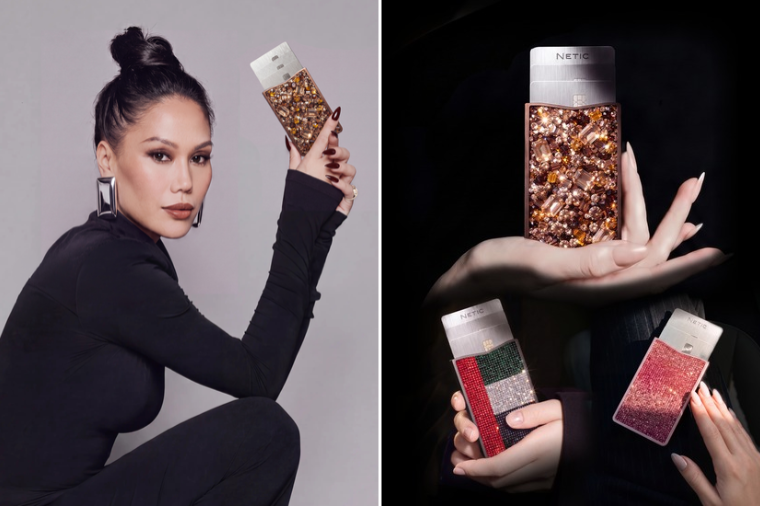
This week, Emirates Woman speaks to Vi Bui, the Founder and CEO of NETIC, a Dubai-born jewellery wallet brand.
Welcome to the Emirates Woman weekly series ‘How I got my job as…’, where we speak to some incredible entrepreneurs and businesswomen, both based in the UAE and globally, to find out about their career paths that led them to where they are now, what their daily routines look like, the advice they’d give to those starting out, and the hurdles they’ve had to overcome.
As we speak with Vi Bui, the founder of the Dubai-born brand NETIC, she tells us how a childhood spent helping in her family’s sushi restaurant in Trier and ten years in agencies working with Volvo, Telekom and Henkel led her to spend four years developing the Slim Jewellery Wallet, a crystal-set cardholder that glides out three cards on each side with a single push. She takes us through the challenge of building every detail in-house in Dubai with the precision of a watchmaker, and the new colours, artist editions and diamond-set piece she has coming next.
View this post on Instagram
1. What first pushed you to build a product entirely of your own?
Ever since I was six, I’ve dreamed of building my own product. A voice in my head always said: of course it will work, just keep going, you’ll get to the solution. But what truly drives me is the building itself. I love losing myself in creative daydreams, and I love the thrill of being stuck in a dead end, until the solution finally clicks. That moment feels like winning, and it’s exactly what NETIC is made of.
2. What was it like growing up in Trier, in a family of Vietnamese immigrants whose first venture was the town’s sushi restaurant?
Helping in the restaurant was completely normal. At twelve, before school, I’d clean or put the chairs out on the terrace. Over 25 years, I watched how a business is built: a hard start, then waves of good years and bad years. We never had much at the beginning, but I had a beautiful childhood, and that was thanks to my mother. She stayed the same person, in good times and in hard ones. Keeping a sunny spirit through everything is something I try to remember every day.
3. Your family believed that what you can’t buy, you can build yourself. Where did that show up first in your own life?
It started with my father. In kindergarten, I was obsessed with push-pop lollipops, and when mine was finished, I wanted another. Instead of buying one, my father melted down the sweets we’d caught at the carnival parade, shaped a mould from aluminium foil around his finger and cast a new lollipop. That’s my first memory of taking things into my own hands with creativity.
4. You made your first designs at six from kitchen towels and safety pins. What do you still recognise from those dresses in your work today?
They were just grey kitchen towels. But I didn’t see grey. I saw every colour, the design, and myself wearing it. Of course, the dresses looked terrible, and I got into huge trouble with my mother for cutting up all her towels. But I didn’t beat myself up. It didn’t work, so I made something else. I believe we are all born with a beautiful, courageous madness: the certainty that we’ll make it, long before we know how. Most of us just forget it along the way. That beautiful, courageous madness is still in every NETIC I design.
5. How did years of piano, including time at the conservatory in Luxembourg, shape the way you design?
Today, I design without asking for permission. Bringing something new into the world always feels awkward at first. But I remember quitting piano at fifteen, because my parents had lost faith in me becoming a concert pianist. They had their reasons, but I still loved playing, and I quit anyway. What I regret is that I didn’t simply carry on and do my own thing. Since then, I push raw, bold ideas, and when I design, I’m fearless about how I’ll reach my vision. Getting there is only a matter of time.
6. After ten years in agencies working with Volvo, Telekom and Henkel, which skills carried over to NETIC and which did you have to drop?
At my first agency, they tried to turn me away: why should we hire you, you can’t do anything? I didn’t take no for an answer and offered to start as an intern. Two weeks later, I had a permanent contract. That’s where I learned to fight for what I want: when nobody knows yet what you’re capable of, you must be extra brave. Agency life was a masterclass in managing pressure: several six-figure pitches a week, concepts thrown out at ten at night and rebuilt by morning, because there always had to be a better, bigger idea. I carried all of that into NETIC: the high bar, creative solutions under pressure, the speed. Those years were also lonely. Loneliness makes you do things that feel right to you but make no sense to anyone else. That taught me compassion: when someone’s behaviour doesn’t seem logical at first, I go two steps further to really understand it, my own included. That’s how I lead NETIC today. What I had to drop were the Friday afternoons: going home and not thinking about work for two whole days. Those days are rare now, and every time one comes along, it feels like New Year’s Eve, fireworks included.
7. Where did the idea of joining a card wallet with a piece of jewellery come from?
It was Dubai, its energy and the people I met here. I asked myself: why does a wallet have to be purely functional? Why not dare to make something truly extraordinary, something that gives you that wow feeling every time you touch it? Cardholders like this have mostly been designed by men, for men. Women deserve one built around them, where tech and glamour come together. NETIC turns geeky into glamour. That’s how we created a new category: the Slim Jewellery Wallet.
8. You and Marcel Al-Naama taught yourselves CAD and precision manufacturing. What was the hardest part to get right in four years of development?
Anyone can make a wallet. The biggest challenge was making it small, light and extraordinarily beautiful. A slim wallet misses its whole purpose if it’s thick, bulky and awkward to use, like so many of the hundreds I had tested. Trained engineers told us my vision of a wallet wasn’t possible. There were so many moments when it couldn’t work. We 3D-printed so many prototypes that with all that material, you could have printed a Lamborghini. I’ve taken the wallet apart and put it back together more than 10,000 times. Then conflict reached the region and disrupted our supply chain. We didn’t stop. The NETIC 3:3 Pop – one push, and three cards on each side glide out perfectly – works like clockwork. A deviation the width of a hair is enough to stop it. So every NETIC is assembled here in Dubai with the precision of a watchmaker and the care of a jeweller, and passes through several quality controls. That’s where the control enthusiast in me gets to run free.
9. How do you and Marcel split the work as CEO and COO, and where do you push back on each other?
Marcel is my husband, my partner in business and in life. He is the most real, honest and confident person I have ever met. He built an emotionally safe space for me where I can create. I’m the introvert, he’s the extrovert. Together, we’re a kind of superpower. Where do we clash? I’m a planner. I think everything through in advance, set up systems, and I could make a PowerPoint for absolutely anything. Marcel is brilliant at being spontaneous. That’s where we sometimes butt heads. As CEO, I hold the vision for the company and the product, and I lead product development, design, brand and the entire production. As COO, Marcel brings 25 years of experience in marketing and business. He leads finance, operations, logistics, customer relations and our relationships with partners and stakeholders.
10. Why was it important to develop everything in-house with no white label?
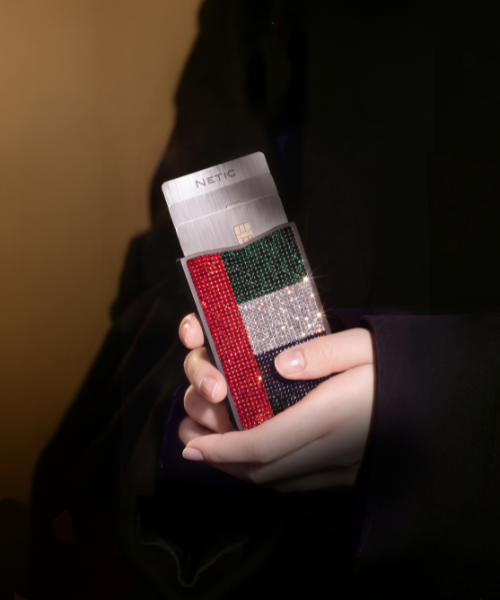
Buying a ready-made product and simply putting our name on it, what the industry calls white label, never crossed my mind. I tried so many slim wallets, and none convinced me: too thick, too tight, too fiddly. A beautiful one simply didn’t exist. At NETIC, we develop every detail in-house, and every piece goes through our own proprietary testing before it reaches its owner. Because we build for longevity.
11. How does the Slim Jewellery Wallet work, and how do you want a woman to use it from morning to night?
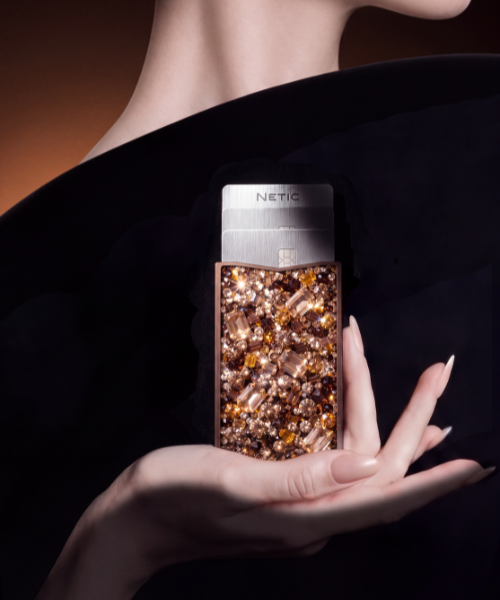
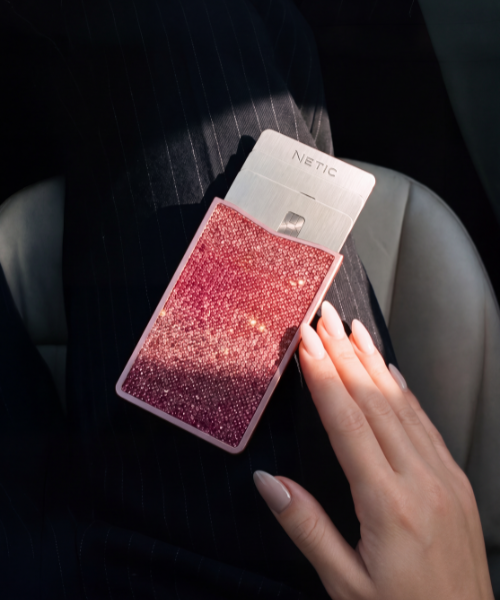
We all know it: bulky wallets stretching our favourite small bags, cards held together with a hair tie to fit into a clutch. And when people say they pay with Apple Pay anyway, that’s exactly why NETIC exists: the few cards we still carry deserve something beautiful. Only crystals with maximum brilliance make it into a NETIC. The 3:3 Pop opens with a satisfying click, and even with long, manicured nails, your cards glide out in one smooth slide. Often, the woman next to you will ask: wait, what is that? For years, NETIC existed only in my own hands. The first time I saw a woman take hers out of her bag with shining eyes, I was almost moved to tears. When the Emirates Woman team loved it in our first meeting, I felt it again: something that began in my imagination now excites other people. I want every woman who carries NETIC to see it as her personal talisman: a reminder, right in her own hand, that she is a woman who wins.
12. What brought you to Dubai in 2024, and what comes next for NETIC?
I never planned to leave Germany. It was a sense of adventure, the wish to do something big and bold. We didn’t overthink it. We just did it. And Dubai gave something back: a vibe I’ve never felt anywhere else, futuristic, full of energy, free. Without Dubai, NETIC would never have existed. Born in Dubai, engineered with German precision, made for women around the world. Next, the Crystal line will get new colours. The Couture line, with up to 600 hand-set stones, becomes a canvas for artists: editions of 99 pieces that bring heritage and culture into an everyday object. A wallet that is also a piece of art. And a NETIC fully set with diamonds is already in the making. At NETIC, the more extraordinary the idea, the more we want to make it happen.
– For more on luxury lifestyle, news, fashion, and beauty, follow Emirates Woman on Facebook and Instagram.
Images: Supplied


