


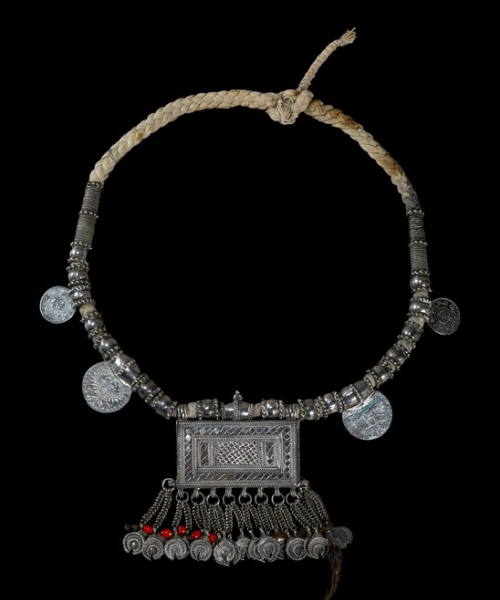
Long before the diamond- and gold-lit boutiques of modern Dubai, the identity of an Emirati woman could be heard before it was seen. It lived in the rhythmic, metallic chime of heavy silver khalakheel at the ankle and the weight of coins on her chest. In the pre-oil Trucial States, adornment was never an accessory. It was financial security, worn out loud. This is the historic essence of Zinah wa Khazinah, the traditional Arabic idiom meaning beauty and wealth in one. Walk into the Traditional Jewellery House at Al Shindagha Museum in Dubai, and you see at once that jewellery here was never only ornament. It carried a woman’s status and her milestones, and in the days of the Bedouins it was her wealth, kept close to her heart. Of all the pieces on display, it is the hirz that stays with me: a necklace of Maria Theresa thalers strung on a textile cord between silver beads, gathered around a heavy rectangular pendant. Sealed inside the pendant was a written verse, while the chains below it would jingle as the wearer moved. An Emirati woman would be carrying her protection twice over: her faith and her wealth. The Maria Theresa thaler, also known as the Riyal Faransi, weighed 28.07 grams at 83.33 per cent silver, its standard so strictly maintained that it circulated as common currency across Arabia for generations, and was prized as one of the purest sources of silver a jeweller could obtain. The hirz was not jewellery that resembled money. It was money.
 Weighing jewellery for its intrinsic value is second nature to me. On my own wrist sits a heavy antique silver piece from my Berber heritage, passed down by my mother, which once served as her family’s portable reserve. These adornments were travelling bank accounts. They signalled social standing, and they carried a stark practical reality: the coins could be removed, melted down, and traded in times of hardship. Haleema Al Sayegh, whose family has crafted jewellery in the Emirates since about 1850, remembers that in Bedouin times gold belonged to certain families, while silver was common, and known as sadiq al-qaba’il, the friend of the tribes.
When Emirates Woman launched its first issue in 1981, the women reading it were living through the tail end of that world. The nation was undergoing a profound cultural reallocation of assets. Two decades of oil wealth meant that the traditional reliance on heavy silver kholkhal and trade coins slowly faded from daily life.
Taste shifted decisively to yellow gold, signalling a new era through sweeping statement pieces like the cascading morta’sha collars. Jewellery transitioned from a protective reserve into a celebratory store of value.
That inaugural generation of readers are now mothers and grandmothers, the last to understand what it meant to physically transport their wealth. In 1975, Emirati women made up 2.2 per cent of the workforce. Today, the daughters and granddaughters of those 1981 readers are highly educated, globally travelled executives and leaders. They no longer need to wear their assets. Instead, they are building them. Within a single generation, the paradigm has shifted entirely: the UAE now counts nearly 50,000 Emirati women entrepreneurs, according to the Minister of Economy and Tourism, speaking in conjunction with Emirati Women’s Day 2026.
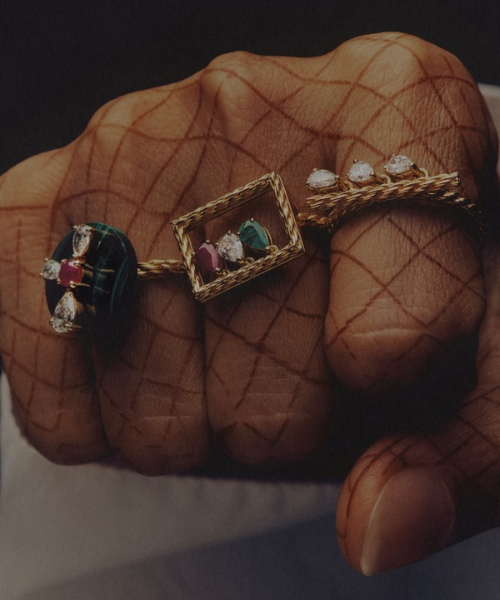
The transformation extends deeply into the country’s capital markets as well. The UAE’s capital markets regulator reported in August of this year that Emirati women hold Dhs63 billion in the country’s markets, while ADX Group, which operates the Abu Dhabi Securities Exchange, says close to 125,000 of them invest actively on that exchange alone. But the most interesting move is not the capital. It is what this generation is doing with their grandmothers’ codes. They are converting that ancestral history into luxury brands sold internationally. By translating the geometric motifs of Bedouin silver, the iconography of the Riyal Faransi, and the legacy of the Gulf’s pearling industry into minimalist gold and diamond collections, they have rewritten the business model. Where the previous generation saw physical weight, contemporary Emirati designers see narrative.
MKS Jewellery, founded by Her Highness Sheikha Mariam bint Khalifa bin Saif Al Nahyan in 2013, twists gold intricately into Al Yada to mirror the rugged ropes once used by Emirati pearl divers. The same shift towards ancestral storytelling runs through 94 Jewelry, a homegrown house co-founded by six Emirati sisters. Rooted in the belief that fine jewellery is a vessel for memory rather than static adornment, the sisters craft their minimalist silhouettes to serve as modern heirlooms: timeless, narrative-driven pieces designed to be passed down from generation to generation. These brands are no longer selling precious metals by weight. The pearl, the gold, the silver: all of these have a market price. What they sell is the weight the market could never hold, the intangible value of generational memory. By untethering these ancient symbols from their literal weight in metal, a new generation has proven that heritage is the ultimate asset. A grandmother’s emergency reserve has become a granddaughter’s intellectual property. And in the process they have turned Zinah wa Khazinah into something entirely modern: beauty, wealth, and an unbroken cultural legacy that no hardship can ever melt away.
October’s—The Celebratory Issue—Download now
– For more on luxury lifestyle, news, fashion, and beauty, follow Emirates Woman on Facebook and Instagram.
Images: Supplied


