




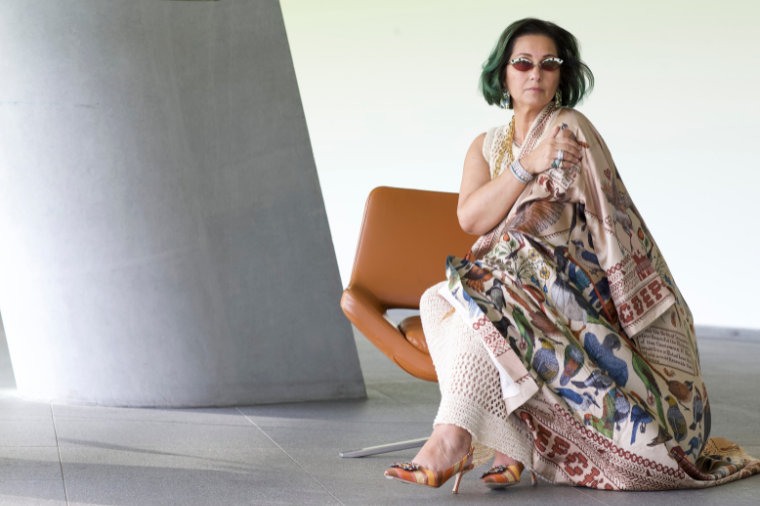
Some stories are written in words, while others are stitched in silk, threaded in gold, andworn as an homage to cultural heritage. For Dr. Reem El Mutwalli, who’s an art historian, cultural scholar, and founder of The Zay Initiative, the story of the UAE lives in its fabric.
Across four decades, she has documented and preserved the evolution of Emirati women’s dress with the precision of a scholar and the heart of a storyteller. Her mission is as poetic as it is purposeful: to record what is vanishing and reframe it for a new generation, one that lives at the crossroads of memory and modernity.
“When you live through transformation, you realise howfragile culture can be and how vital it is to record it before it disappears,” states Dr. El Mutwalli with conviction.
Born in Iraq and raised in Abu Dhabi, she grew up during the UAE’s nascent years, a time when the country’s foundations were still being built. Her father served as economic consultant to the late Sheikh Khalifa bin Zayed Al Nahyan, and her family’s world intertwined with the visionaries shaping the nation’s future. “I experienced the UAE’s formation,” she recalls. “As children, we witnessed the country grow from sand to skyline. That instilled in me a responsibility, to give something back to a place that gave me everything. And what better gift than to record its story?”
That sense of stewardship guided her path from early studies in interior design in the United States to postgraduate degrees in Islamic art and archaeology in the United Kingdom. But education was never separate from life. “My parents were collectors and intellectuals. Art and design were part of daily existence, the way we lived, the way we saw beauty. I simply learned to look more deeply.” Dr. El Mutwalli’s book, Sultani: Traditions Renewed; Changes in Women’s Traditional Dress in the United Arab Emirates During the Reign of the Late Sheikh Zayed bin Sultan Al Nahyan (1969–2004), is more than a record, it’s a visual time capsule. “My book goes far beyond the abaya alone,” she explains. “It explores the full spectrum of Emirati women’s dress during the late Sheikh Zayed’s era. While the abaya, also known as the abah, dafah, or sway’ yah, remains central, I wanted to trace the changes through the eyes of the women themselves.”
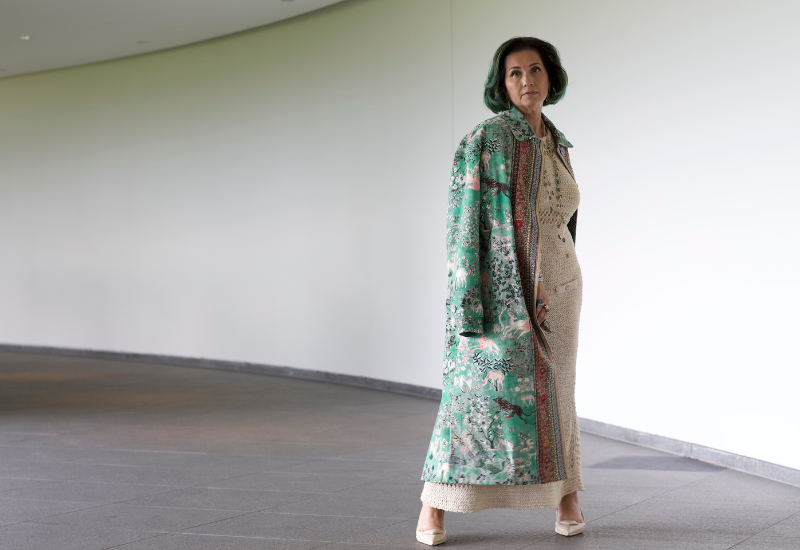
From hand-embroidered cloaks of the 1960s to today’s jewel-toned, stylised designs, Sultani captures the evolving relationship between tradition, identity, and artistry. “It became both a tribute to Emirati women – their dignity, creativity, and adaptability – and a scholarly record for future generations.” She describes each piece as “a portrait of the UAE in motion, a nation balancing continuity and change.”
When asked about the new wave of Emirati designers reinterpreting traditional dress, her tone brightens. “What excites me most is how young designers honour heritage while fearlessly experimenting with form, fabric, and symbolism,” she says. “Their work proves that heritage is not a limitation, it’s a source of endless inspiration. It’s deeply rewarding to see this generation express cultural ownership in its own contemporary voice.” For Dr. El Mutwalli, this interplaymof past and present is what keeps culture alive. “Tradition must breathe. The abaya can carry centuries of meaning andmstill feel utterly modern when reimagined with intent.”
In 2019, she founded The Zay Initiative and its companion project, The Memory Closet, transforming her private archive into a digital museum for the Arab world. Her mission is succinctly expressed in The Zay Initiative’s guiding statement: ‘To collect the tangible, to narrate the intangible.’
“The idea stemmed from realising how vulnerable tangible heritage – including textiles, garments, oral histories – is to time and loss,” she explains. “By digitising these narratives, we ensure accessibility, longevity, and inclusivity. The Memory Closet allows individuals to contribute their own stories, turning personal memories into shared heritage.” “Through digitalisation, we transcend geography,” she adds. “Anyone, anywhere, can explore Arab dress history, learn from it, and feel connected to it. It’s heritage without borders.” Beyond preservation, The Zay Initiative acts as a bridge between scholarship and creativity. “It’s a resource for academics and designers, but also for anyone curious about identity and material culture,” she says. “By placing Arab dress within a global context, we invite critical dialogue and cross-cultural understanding.”
“When you live through transformation, you realise how fragile culture can be and how vital it is to record it before it disappears.”
The initiative’s open-access model has already influenced a new generation of historians and creatives. “When a young designer discovers the symbolism of a traditional weave or stitch, it changes how they design,” she notes. “They’re not just creating fashion, they’re continuing a lineage.” The author believes the intersection of technology and heritage is where the future lies. “Technology allows us to reimagine how we engage with history,” she says. “Through digitisation, AI, and immersive storytelling, we can archive and share our culture on an unprecedented scale. It turns static collections into living dialogues, accessible across borders, languages, and generations.” She views this shift not as replacement but revival.
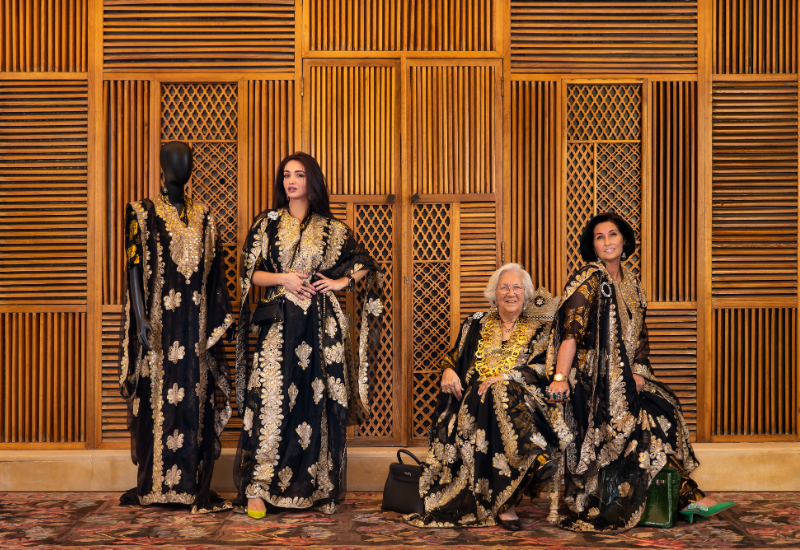
Above: What one began, the others continue – a legacy in fabric. Three generations: my mother, my daughter and I
in a composite image wearing one timeless Iraqi over garment (Hashmi) – a heritage woven in every thread
“Translating something so tactile, so personal, into the digital world was emotional,” she admits. “Textiles carry the touch of their makers. I feared losing that intimacy. But I soon realised that digital storytelling expands empathy. It connects a global audience to the personal histories of Arab women. It transforms nostalgia into knowledge.” Having devoted her life to studying Arab women’s dress, Dr. Reem says the garments have taught her as much about humanity as about fashion. “You learn about dignity, perseverance, craftsmanship, love. You see how culture and identity shape one another,” she reflects. “These clothes were often made by men for women – so they tell stories of collaboration and care. Heritage, in the end, is a human legacy.”
The UAE’s creative landscape, she adds, continues to mature beautifully. “Our institutions and designers are engaging with heritage as a living resource. Preservation isn’t only about aesthetics, it’s about understanding, documenting, and educating. The balance between innovation and authenticity is still evolving, and that’s what makes it so exciting.” While speaking about the UAE today, her voice softens. “I’m part of what’s called Zayed’s generation, those who grew up during his reign,” she says. “I’ve witnessed a nation transform within a single lifetime. What began as modest ambition has become a sophisticated cultural ecosystem. Yet even amid the skyscrapers, I still see echoes of the desert, resilience, generosity, belonging.”
As she continues to build The Zay Initiative’s ever-expanding archive, her vision remains grounded in gratitude. “Culture is identity,” she says simply. “To know who you are and where you come from allows you to understand where you’re going. Preservation connects us across time, across borders and across generations.”
– For more on luxury lifestyle, news, fashion and beauty follow Emirates Woman on Facebook and Instagram
Images: Supplied & Photography by @broosk_saib


